Search on HDHL
Filters
75
results found for 'Prevention'.
- Background and aimThe Joint Programming Initiative on a Healthy Diet for a Healthy Life (JPI HDHL), involved 28 research institutes from seven European countries and New Zealand combined their expertise to form the Policy Evaluation Network (PEN). PEN, true to its vision, has improved knowledge, tools and capacity among its network and beyond to identify, evaluate and benchmark policies designed…
- Background and aim There is an urgent need to find reliable early biomarkers of the cardiometabolic syndrome (CardMetS) allowing intervention before irreversible damage develops while assessing the efficacy of nutritional prevention. Oxylipins could be relevant candidate biomarkers thanks to their involvement in the homeostatic regulation of various process related to the cardiometabolic status…
- Background and aimThe human gut microbiota is a complex ecosystem consisting of hundreds to thousands of distinct bacterial species which provide important immune, metabolic and trophic functions for their host. Our knowledge on the processes contributing to microbial dysbiosis has a direct impact on our ability to manage and maintain human health. Early childhood appears a crucial age-window…
- Image
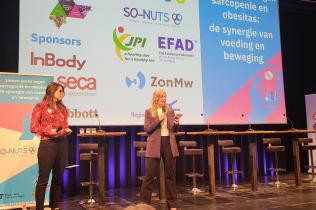
On March 22nd, the symposium on the conditions of Sarcopenia, obesity, and sarcopenic obesity took place. Read in this news article how multidisciplinary teams prevent and combat these conditions. - Background and aimRecent findings convincingly demonstrate that Advanced Glycation End Products (AGEs) are modifiable by diet and reflect changes in healthy state. SALIVAGES investigates whether that diet-induced AGEs can act as reliable biomarkers of changes in health status and/or risk, focusing on the most highly accessible source of AGEs, the saliva. The main objectives of SALIVAGES were the…
- Background and aimHEALTHMARK investigated the complex associations between diet, microbiota, tryptophan metabolites of microbial metabolism, and metabolic health in a set-up of identification, replication, and validation of associations. The project, organized in five work packages (WP) comprised two observational and two intervention studies.In WP1, the University of Bonn (UB) using the DOrtmund…
- Background and aim:Studies suggest that the intestinal microbiome modulates the risk of several chronic diseases, including type 2 diabetes, allergy, cardiovascular disease, and colorectal cancer (CRC). Dietary factors are related to chronic disease risk, and they have been suggested to modulate the composition and function of the gut microbiome. However, detailed knowledge on the relationship of…
- Determinants of Diet and Physical Activity; Knowledge Hub to integrate and develop infrastructure for research across Europe: From December 2013 until December 2016 the research network ‘DEDIPAC’ was active. DEDIPAC stands for ‘DEterminants of DIet and Physical ACtivity’. The main goal of DEDIPAC was to establish a research network (Knowledge Hub) of researchers from different countries and…
- Background and aimThe VALID project aims to validate plasma valerolactones as stable biomarkers of catechin- and procyanidin- rich foods and to demonstrate their association with markers of metabolic health, inflammation and cognitive function in an older European population, building upon the existing TUDA study of 5,186 older adults. The VALID project has 5 objectives, to evaluate:Plasma PVLs…
- Early life is fundamental for brain and microbiota development. Gut microbiota influences brain function. Maternal obesity affects maturation of gut microbiota and is an important predictor of cognitive dysfunction in the offspring. Cognitive decline through life is an increasingly invalidating condition, due to population ageing and the high frequency of predisposing factors (obesity, unhealthy…
- Background and aimSub-optimal status of Riboflavin (vitamin-B2) may be more widespread than generally recognised because of reliance on dietary data only in many nutrition surveys and lack of reliable biomarker data. The DERiVE project aimed to address this by developing accessible riboflavin biomarkers and by demonstrating important functional, gene-nutrient and health effects of optimal…